
 By
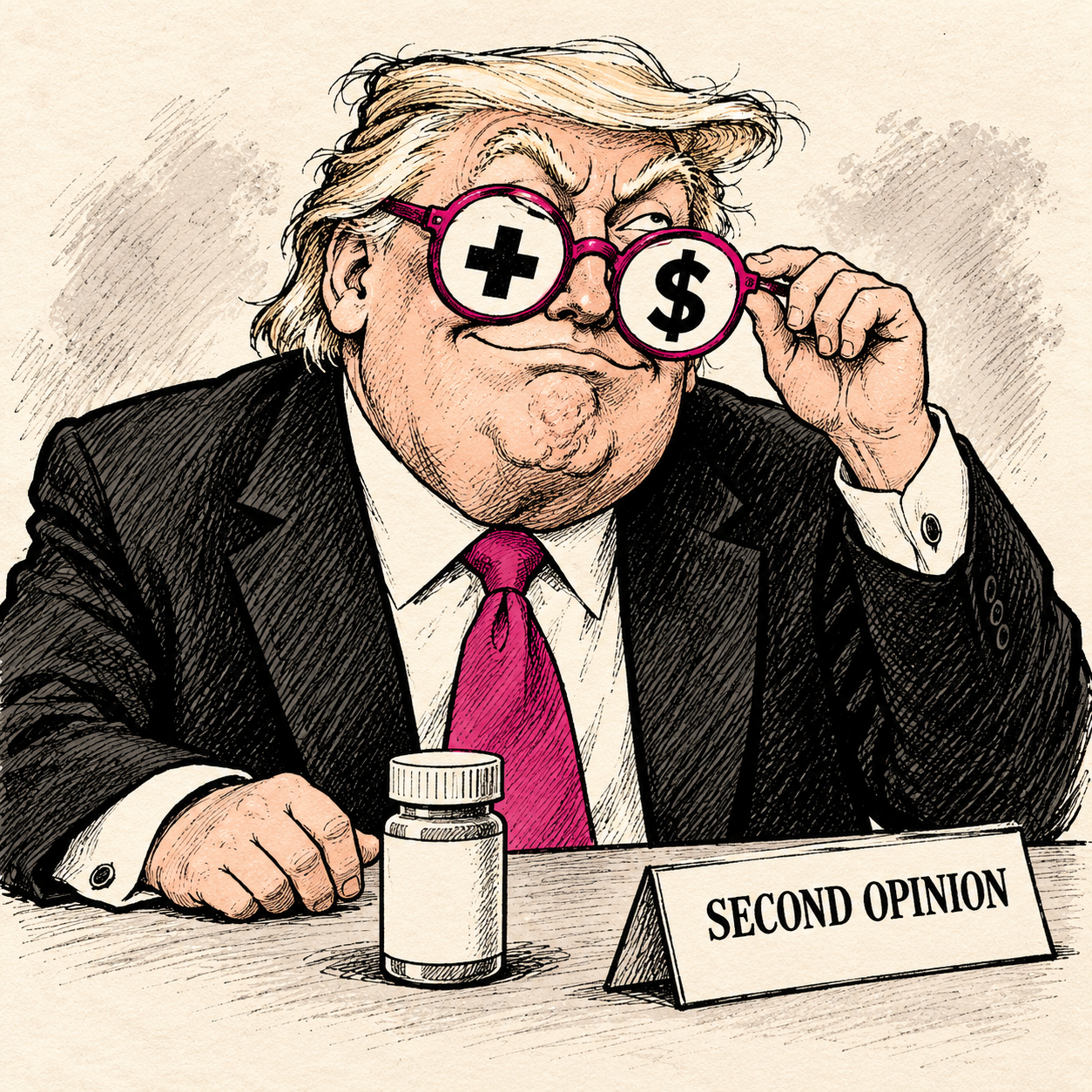
By At last, a presidency equipped to appreciate both sides of the drug-price debate: the person trying to afford the prescription and the shareholder hoping the manufacturer remains in excellent financial health. Truly diversified empathy.
AP reported October 16 that congressional Democrats’ analysis put Trump’s year-end 2025 holdings in drugmakers benefiting from negotiation exemptions at up to $39.1 million. That is a reported upper-bound holding value, not a measured profit. The White House denies a conflict and says third-party financial institutions manage the portfolio without Trump or his family directing investments.
Congratulations to the corporate-relations team. The administration can promise relief to patients while its president owns an interest in businesses on the other side of the price discussion. The stock purchases need not have been personally selected for the overlap to be embarrassing. Independent management of the basket does not make the basket belong to someone else.
CMS’s final guidance for the 2028 negotiation cycle confirms the policy mechanism. The law broadened the orphan-drug exclusion to cover products designated for one or more rare diseases when all approved indications are for qualifying rare diseases. Previously, the exclusion was limited to a single rare disease. This is a specific eligibility carveout, not the abolition of Medicare negotiation. CMS presents it as preserving incentives for rare-disease research.
A magnificent piece of product positioning: the negotiation program remains fully operational, except where the product has successfully applied to be somewhere else. From the patient’s perspective, a lower price is the objective. From the shareholder’s perspective, not having to discuss a lower price can also count as a healthy outcome. Please specify which health you mean before the earnings call begins.
There is a serious research-incentive argument here. Developing treatments for rare diseases matters. It does not follow that every exemption is optimally designed, or that a president’s ownership interest becomes irrelevant because the underlying medicine is valuable. A valuable drug can save lives and sell for a price worth negotiating. The molecules do not become less heroic when someone asks about the margin.
The pharmaceutical-ad version of this arrangement would be a masterpiece. A reassuring narrator promises affordability while a much faster narrator explains that the man leading the affordability campaign has a portfolio containing protected manufacturers. The sunset is beautiful. The conflict discussion has been mixed below the sound of the canoe.
The reporting does not establish a corrupt bargain. Public drug-price champion and private drug-company shareholder are nevertheless two job descriptions that would normally call for different business cards. Combining them saves paper, which may be the only economy in the arrangement that requires no additional explanation.
For boardroom purposes, this is an unusually broad understanding of patient-centered care. The administration can care about the patient’s costs, the company’s research incentives and the president’s assets. Only one of these interests has to decide whether to fill a prescription before payday; naturally, that is the one asked to admire the complexity.
The board thanks everyone for their commitment to lower prices, stronger incentives and maintaining an extremely flexible definition of relief. Please enjoy the soothing pharmaceutical-commercial music while we move from public health to portfolio health.
Ask your broker whether lower drug prices are right for you.