
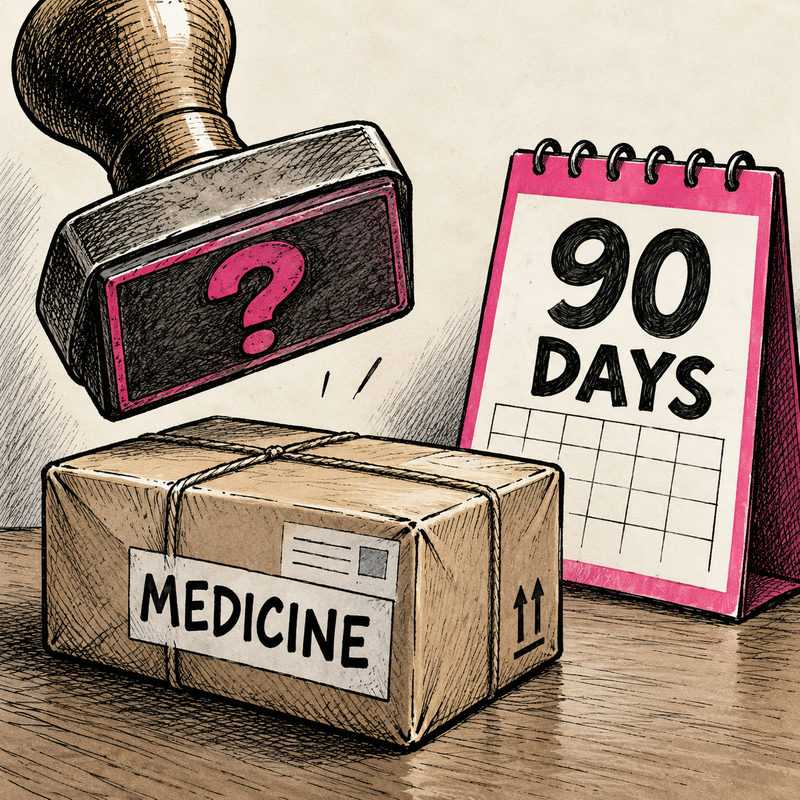
Americans who receive medication from Canada have been given another 90 days before a new customs requirement takes effect. In the language of government, that is a compliance extension. In the language of a person trying to keep receiving a prescription, it is three more months of wondering what happens afterward. A very generous refill of uncertainty.
The Associated Press reports that the administration has delayed rules affecting low-value shipments until January 20, 2027. After that, medications mailed from abroad will require additional data and a bond guarantee. The affected purchases include personal medications from Canada, including drugs unavailable in the United States.
This is not a reported blanket ban on Canadian medicine. It is an additional entry requirement, postponed rather than withdrawn. Keeping that distinction straight matters. So does asking why continued access to treatment has become something people must understand through the finer points of international parcel processing.
Customs says the extra time supports compliance and efforts to identify illegal or unsafe goods. Safe medicine matters. Nobody needs a liberal defense of counterfeit pills. But a safety rationale should lead to an explanation of how patients keep receiving legitimate treatment, not merely how efficiently the government can make the package more complicated.
I want that access treated as part of the job. A system can successfully process a shipment and still fail the person waiting for it. Bureaucratic success is an impressive product: it can remain in stock even when everything useful is unavailable.
The reported changes cover shipments below $800. A dollar threshold is convenient for categorizing merchandise. It tells us rather less about what a delayed medicine means to the recipient. The package does not become medically optional because its declared value fits inside a relatively modest box on a form.
We've looked at the conflicting interests surrounding drug-price policy. This is another reason to judge policy from the patient's end. A promise of better healthcare is not fulfilled when the government successfully routes a person toward a more elaborate problem.
There may be a workable process here. The AP dispatch does not establish that every shipment will be stopped or quantify the added cost. I won't manufacture either outcome. What is already clear is the new requirement and its new deadline. Those are enough to justify demanding a practical explanation before people discover the answer through an interruption.
Use the extension to make the legitimate route understandable and usable. If an additional guarantee is necessary, explain who supplies it and how people obtain their medication while the process changes. That is not asking Customs to become a hospital. It is asking it to notice what is inside the parcel.
Ninety days can be time to solve the problem or time to move the problem farther away from today's announcement. Patients should not have to wait until January to learn which kind of generosity they received.
Comments
Have something to say? Give this story a heckle.
Comment Rules
Argue the point. Add a joke. No threats, harassment, hate speech, spam, private personal information or unsupported accusations. First-time comments and comments with links are moderated. Full Comment Rules
Loading comments…
Questions or deletion requests? Contact Us. We retain comments and moderation records until removed. Only hashed email identifiers are stored for comment accounts.