
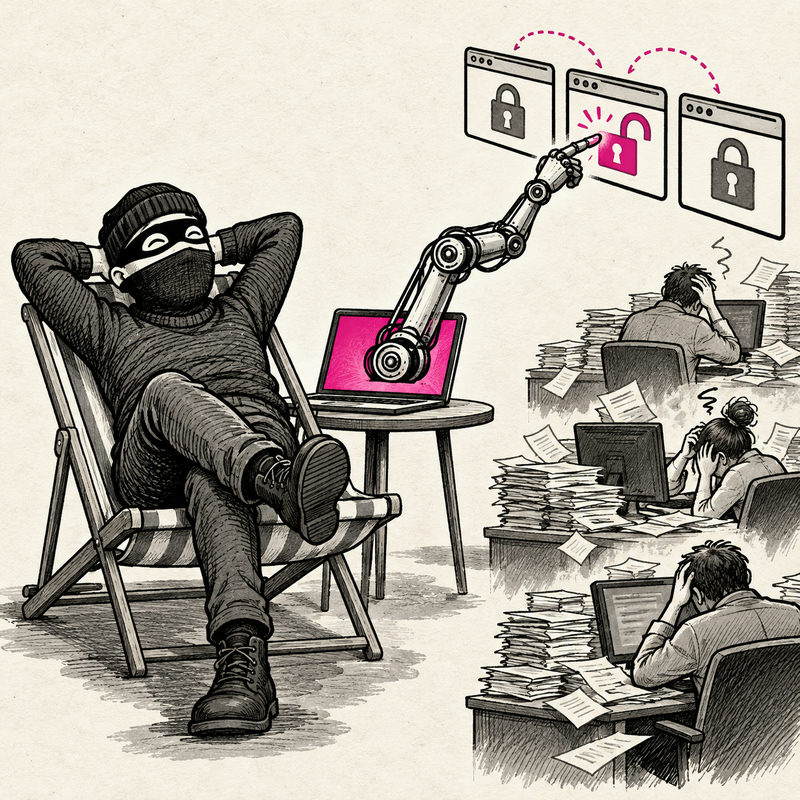
The productivity revolution has reached the person breaking into your website. Excellent. We were all worried that cybercrime involved too much hard work.
Reuters reports that a researcher observed one hacker using AI agents to compromise more than 100 organizations' websites. He estimated roughly $5,000 in computing costs. Reuters independently identified victims from the activity records, but could not establish how much data was stolen. Several companies described limited effects or remediation.
So no, this does not mean every breached company lost every secret. It means a malicious operator could delegate lengthy intrusions at a price that should make the people selling effortless autonomy considerably less pleased with themselves.
The criminal got a productivity gain. Everybody else got a security assignment.
That distribution bothers me more than the spectacle of software being clever. The thief can try again cheaply. A small organization has to protect itself repeatedly, keep operating, and explain anything that goes wrong. One side gets to experiment. The other side gets to discover which experiment it was.
We discuss technological progress as though saving labor necessarily saves decent people labor. Sometimes it saves an asshole labor and creates an evening of unpaid incident response for someone who was hoping to go home. There should be room for that possibility between the keynote and the standing ovation.
The researcher described successful intrusions taking about 23 hours. This is not a magic button instantly opening every lock. It is something more practically unpleasant: persistence that no longer requires a criminal to remain personally interested. The attack can keep working while its operator enjoys the work-life balance the rest of the technology sector keeps promising.
Cairn's creator says the platform was not designed for attacks. Intent matters, but it cannot be the end of the discussion. Nobody needs to have invented a tool for a bad use before the bad use becomes a problem worth addressing. A sincere explanation of the original vision is not a security patch.
The debate over companies assigning responsibility for AI agents concerns what businesses authorize their own software to do. This is the other side of the deployment race: what hostile users can afford to do to everyone else. There is no reason the public should subsidize that race with unlimited exposure.
I want vendors testing abuse at the scale their products enable, interrupting demonstrated malicious use and helping defenders keep up. That is a case for enforceable obligations, not another round of industry-designed limits on government intervention. We should not have to wait until an attack is historically impressive before treating prevention as legitimate.
Useful automation can remain useful with safeguards. The argument that any friction will ruin the future is suspiciously convenient for the people charging by the amount of future consumed.
Give ordinary businesses better defenses and criminals fewer bargains. Otherwise the great achievement of this revolution will be that breaking into your workplace became easier while working there became harder.
Comments
Have something to say? Give this story a heckle.
Comment Rules
Argue the point. Add a joke. No threats, harassment, hate speech, spam, private personal information or unsupported accusations. First-time comments and comments with links are moderated. Full Comment Rules
Loading comments…
Questions or deletion requests? Contact Us. We retain comments and moderation records until removed. Only hashed email identifiers are stored for comment accounts.