
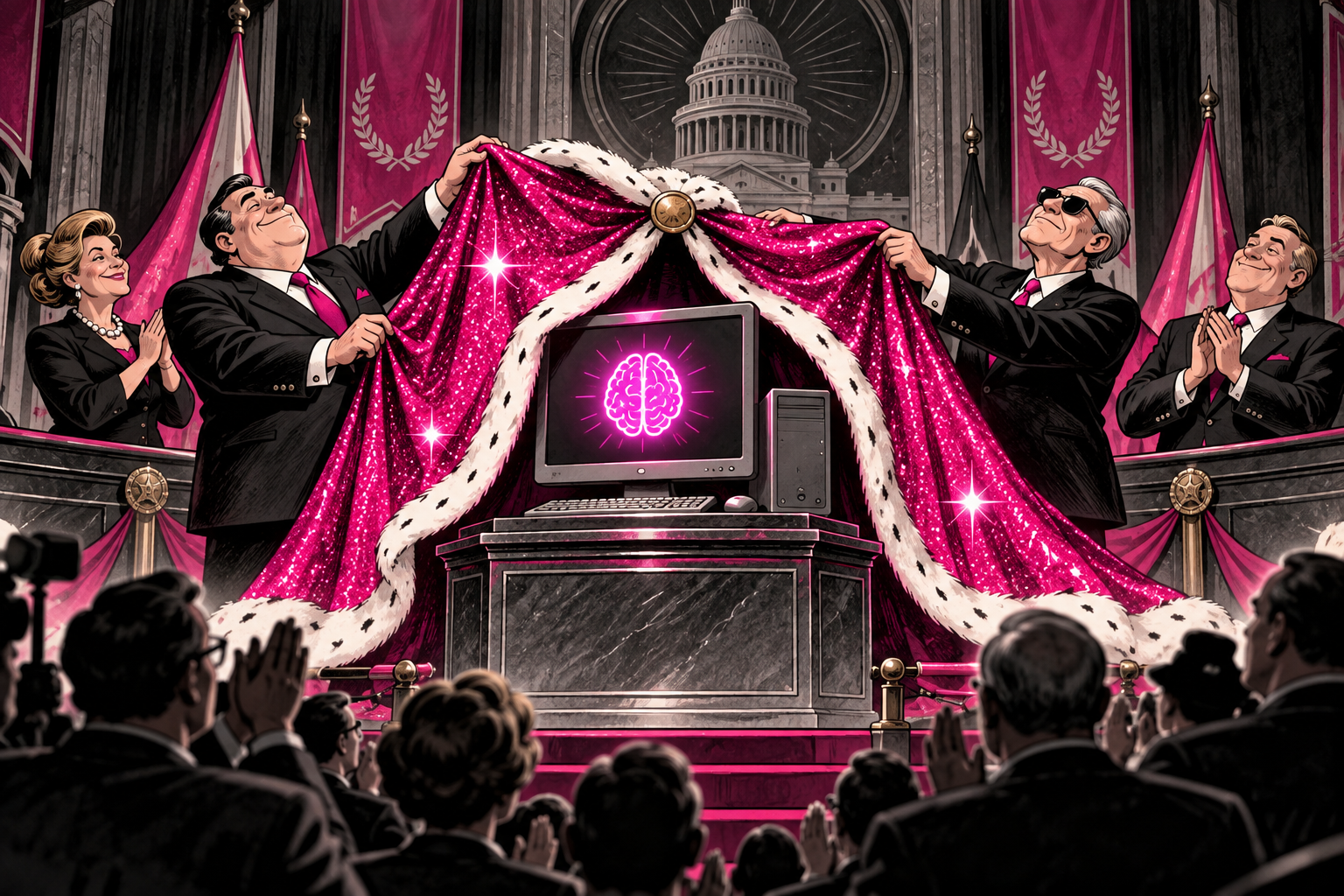
The Trump administration has apparently looked at artificial intelligence — the labor disruption, the privacy problems, the deepfakes, the concentration of power in a handful of corporations — and identified the real emergency: the name is not flattering enough.
Reuters reported Thursday that Treasury Undersecretary for International Affairs Erin Browne said the United States is pressing international partners to use "super intelligence" instead of "artificial intelligence." Washington is even negotiating over the language in a statement from the International Monetary and Financial Committee, the IMF’s steering body. Nothing says sober multilateral economic governance like showing up with a branding deck and asking the rest of the world to clap.
This is not merely an offhand flourish. President Trump signed an executive order on September 29 directing executive-branch agencies, to the maximum extent allowed by law, to replace "artificial intelligence" and "AI" with "super intelligence" and "SI" in official communications and other non-statutory documents. The order says the new terms currently mean the same technologies already covered by the existing statutory definition of artificial intelligence. In other words, the government changed the nametag while the machine kept doing exactly what it was doing five minutes earlier.
A Cape Is Not A Safety Standard
Terminology can matter. Good definitions help lawmakers write rules, researchers compare risks and the public understand what officials are talking about. But that is the opposite of what is happening here. A useful definition narrows ambiguity. This rebrand sprays glitter on it.
"Super intelligence" already carries a specific and contested meaning in technical and policy debates: systems that would exceed human abilities across broad domains. Using the phrase as a catchall for everything currently called AI does not clarify the field. It blurs today’s chatbots, prediction systems and automated decision tools together with a hypothetical future technology. That may be great for a rally speech. It is less great for procurement rules, consumer protections or an honest conversation about what a system can actually do.
The order also asks the president’s science adviser to propose a federal definition and possible changes to existing laws within 60 days. Congress should treat that proposal like any other consequential policy change: demand evidence, hold hearings and ask who benefits. The answer cannot simply be "the vibes department."
Govern The Technology You Have
The administration’s international push makes the stunt more serious. The IMF’s members do not need an American euphemism campaign. They need clear discussions about productivity, energy demand, employment, market concentration, financial risk and the uneven distribution of AI’s gains. Those are hard questions. Replacing two letters with two shinier letters answers none of them.
A liberal approach should be neither panic nor worship. Encourage useful innovation. Protect workers whose jobs are reorganized by it. Require meaningful testing and disclosure in high-stakes systems. Enforce privacy and competition law. Make companies prove their claims instead of letting marketing copy dress up as science.
Call the technology AI, SI or Kevin. If it can deny a loan, shape a hiring decision, imitate a voter’s trusted source or move markets, the public deserves rules that work. A government serious about intelligence would spend less time super-sizing the noun and more time governing the verb.