
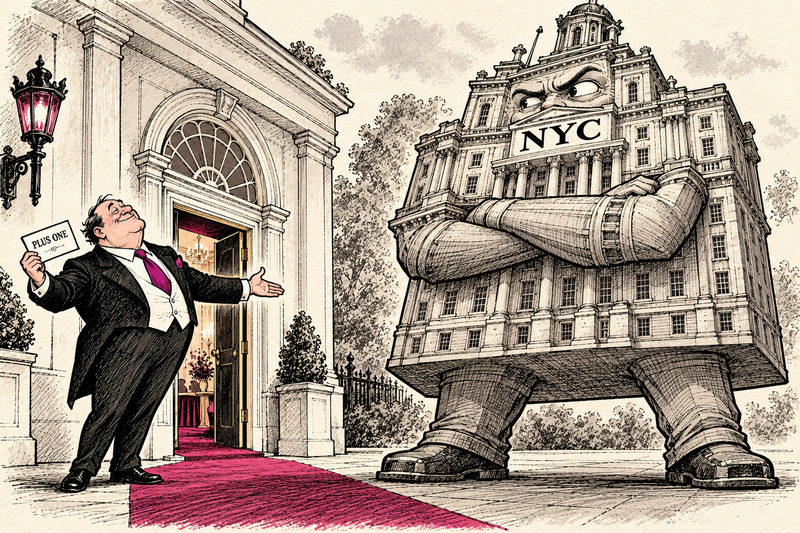
Small government is a beautiful ideal, particularly when the government can remain small by bringing somebody else’s government along. There is no need to expand the guest list if you classify an entire municipal workforce as your plus-one.
A federal judge dismissed DOJ’s sanctuary-law challenge, rejecting compelled New York City participation in civil immigration enforcement, the Guardian reports.
In our imaginary Washington invitation, the host regrets that space is limited. Guests may bring one companion. The federal government has interpreted companion to mean several city agencies, their employees and whatever resources those employees were hoping to use for their existing jobs. It has also requested parking.
This is not big government, our fictional host explains. The federal operation remains admirably lean. The additional government belongs to somebody else. A man who arrives at dinner with twelve borrowed chairs has not increased his furniture collection. He has demonstrated restraint, provided the restaurant does not ask whose chairs they are.
Please Bring Your Own Local Authority
The imaginary invitation promises an evening celebrating local control. Local officials are therefore free to choose how promptly they perform the host’s preferred assignments. They may start immediately or begin without delay. Federalism offers a rich menu of these two options.
An awkward guest asks whether the city agreed to this arrangement. The host is surprised. He invited the city, did he not? Surely being invited to supply the staff is almost indistinguishable from being invited to the party. Both involve arriving at the same building. Only one requires an apron.
The guest tries again. Does the invitation actually mean an invitation, or does it mean an order? Our host dislikes this narrow approach to hospitality. An invitation is warmer. It suggests flowers, mutual respect and a little embossed card. An order suggests that somebody has noticed who is doing all the work.
The host offers a compromise. The local government may continue to call itself independent while its working day belongs to Washington. This costs the federal government nothing and preserves the city’s most important freedom: deciding what color to make the badge on the borrowed uniform.
Somebody proposes a simpler arrangement. Hire and manage the people needed for your own operation. The room falls silent. This is precisely the sort of extravagant suggestion that gives government a reputation for spending money. Has the guest considered the savings available from making another government absorb the inconvenience?
The Guest List Develops An Opinion
Our imaginary host would like to clarify that attendance is optional in spirit. In practice, refusal will be treated as an attack on the evening itself. A city cannot simply decline to provide the waiters without being accused of opposing dinner.
The city points out that declining an assignment is not the same as taking away the host’s kitchen. The host still has a kitchen. He would simply prefer the city’s people to run it while he explains how efficiently his small household operates.
Finally, the fictional invitation returns. The answer is not a competing banquet, a demand for the host’s silverware or a municipal declaration that dinner is forbidden. It is the short answer that every overreaching host hopes the card will not contain.
New York has declined. Apparently a city is allowed to RSVP, not merely arrive in uniform.
The Comment Section Has Entered The Chat.
Argue the point. Add a joke. No threats, harassment, hate speech, spam, private personal information or unsupported accusations. First-time comments and comments with links are moderated. Comment Rules
Loading comments…
Questions or deletion requests? Contact Us. We retain comments and moderation records until removed. Only hashed email identifiers are stored for comment accounts.