
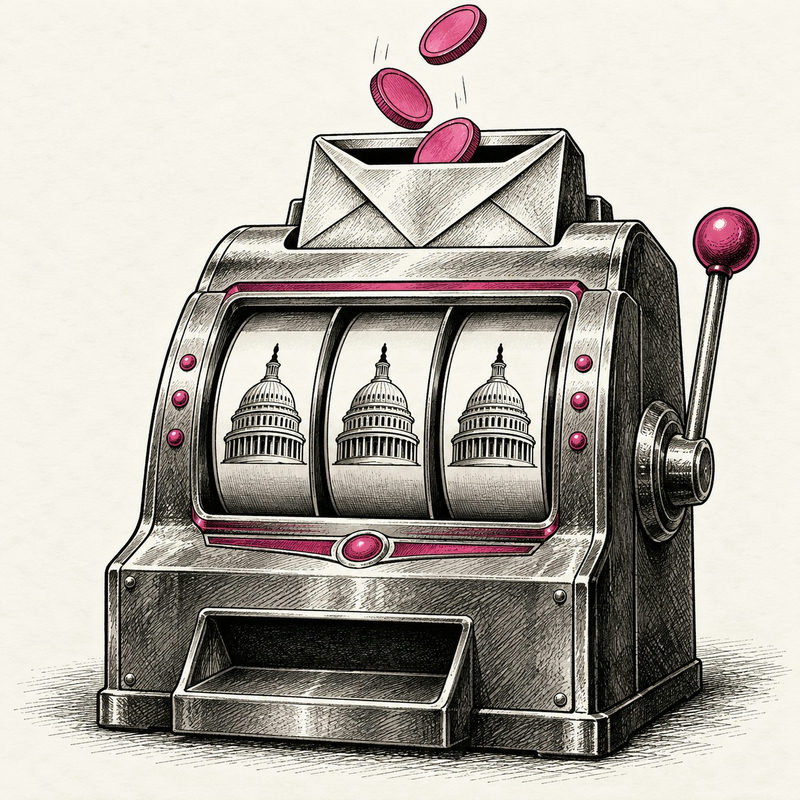
Pennsylvania's skill games industry has had trouble getting the regulatory outcome it wants. It has had considerably less trouble finding the contribution button.
Spotlight PA reports that Republican gubernatorial candidate Stacy Garrity raised almost $5.4 million between September 15 and October 19, including at least $4.5 million linked to skill games. That is more than 80 percent of her fundraising for that reporting period, not 80 percent of every dollar she has ever raised.
The distinction matters. The number is impressive enough without putting it on a growth hormone programme.
Two contributions account for most of the industry-linked total: $2 million from the Pennsylvania Amusement and Music Machine Association and $2 million from skill games developer John D. Conley. Distributor Joseph Rocca gave another $500,000. The association represents a range of coin-operated entertainment businesses, including skill games; it is not exclusively a single-machine lobby.
Garrity has publicly supported an industry-backed regulatory and tax structure and appeared at a pro-skill-games rally. Those positions and those contributions are documented. They do not establish an illegal bargain. The political concern does not require pretending they do: a candidate who favours an industry's desired rules is receiving a very large share of her recent money from people linked to that industry.
This is not hidden machinery. It is the machinery running with the cover off.
The stakes are concrete. Pennsylvania's Supreme Court ruled earlier this year that skill games are legally slot machines and can operate only in casinos and certain truck stops. It delayed enforcement until October 13 to give lawmakers time to act. They did not. Casinos, which compete with the machines, have their own considerable political power, while small businesses and social clubs have relied on skill-game revenue.
Make powerful people uncomfortable.
Subscribe to Democrawonk.
As the earlier legislative fight showed, gathering support for a proposal is not the same thing as delivering a law before a deadline. The new fundraising report shows another part of the effort: helping elect an executive who backs the preferred framework.
Garrity's campaign did not answer Spotlight PA's specific fundraising questions. Its spokesperson instead said the contrast between her supporters and where Josh Shapiro raises money could not be starker. That is an efficient way to respond to a question about four and a half million dollars without discussing any of the dollars.
Shapiro is not outside this industry's fundraising orbit. Spotlight PA reports that he received $50,000 from its main PAC in June, and industry money has gone to lawmakers in both parties. That fact does not make the scale of Garrity's recent haul disappear. It does prevent the story from becoming a comforting fairy tale in which only one party has learned where donations come from.
Nor has the money made the campaigns financially equal. Shapiro raised $8.4 million in the same recent period. Since the beginning of 2025, his campaign has spent almost $70 million against roughly $7 million for Garrity. She remains behind by double digits in the polls described by the report. Contributions purchase campaign capacity, not a certified result.
The useful question is what happens when the people seeking a regulatory decision become such a dominant source of a candidate's immediate financing. Voters deserve a clear explanation of the proposed tax and regulatory system, who benefits, and why it serves the public rather than just its most enthusiastic funders.
The machines may need a new legal home. Their industry's money has found one already.
Comments
Have something to say? Give this story a heckle.
Comment Rules
Argue the point. Add a joke. No threats, harassment, hate speech, spam, private personal information or unsupported accusations. First-time comments and comments with links are moderated. Full Comment Rules
Loading comments…
Questions or deletion requests? Contact Us. We retain comments and moderation records until removed. Only hashed email identifiers are stored for comment accounts.