
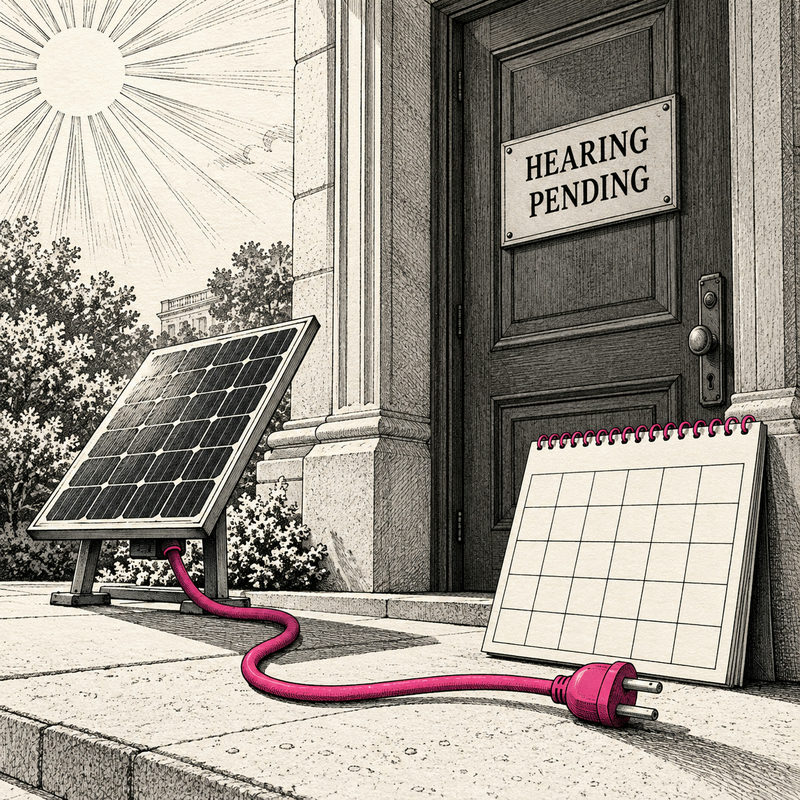
Michigan has found a remarkably effective way to prevent solar power from moving too quickly: put the legislation indoors.
Michigan Advance reports that lawmakers have drafted six community-solar bills since 2021 without enacting one. Four current proposals are sitting in committee with no hearings scheduled. There are Democratic sponsors, Republican sponsors and residents concerned about electricity costs. The remaining missing ingredient is apparently a calendar.
Community solar lets people subscribe to a shared project and receive utility-bill credits for the electricity it generates. That can give renters, households unable to afford rooftop equipment and people with unsuitable roofs a route to participate. It does not mean every subscriber gets a private power supply during an outage; backup depends on the program and equipment.
The live disagreement is about money and grid costs, not whether sunlight is available.
Utilities DTE and Consumers Energy warn that poorly designed credits could shift costs onto people who do not subscribe. House Energy Committee chair Pauline Wendzel makes a specific version of that argument: if credits exceed what a solar facility saves the system, someone still has to pay for maintaining the grid.
That is a real question. A guaranteed discount written into a bill does not, by itself, identify who finances it. One proposal requires minimum savings for subscribers, including larger savings for low-income households. Supporters need to explain the numbers, not simply point at the word “savings” and wait for applause.
Make powerful people uncomfortable.
Subscribe to Democrawonk.
But asking the question is not the same as answering it, and a committee with no hearing scheduled is not exactly putting its calculators through a strenuous workout.
Democratic sponsor Donavan McKinney alleges utility campaign contributions are keeping his bill from a hearing. Wendzel denies that utilities lobbied her to hold it and says she opposes the policy. The reporting does not establish that a donor bought the committee's calendar. It establishes a dispute that the public ought to be able to examine in daylight.
Other states show why details matter. Michigan Advance describes a Massachusetts study finding benefits for nonparticipating ratepayers, while Minnesota redesigned a program after finding its credits exceeded the value of the electricity generated. Neither example proves every community-solar proposal works. Together they do make “let's examine the design” sound rather more useful than “let's never schedule the discussion.”
Utilities already offer renewable-energy subscriptions, but the article reports costs to customers rather than the bill savings the legislative supporters seek. Those are different products, and residents deserve a clear comparison.
A hearing cannot guarantee cheaper electricity. It can require people defending competing claims to explain them in the same room.
Five years of proposed legislation should be enough time to locate one.
Comments
Have something to say? Give this story a heckle.
Comment Rules
Argue the point. Add a joke. No threats, harassment, hate speech, spam, private personal information or unsupported accusations. First-time comments and comments with links are moderated. Full Comment Rules
Loading comments…
Questions or deletion requests? Contact Us. We retain comments and moderation records until removed. Only hashed email identifiers are stored for comment accounts.