
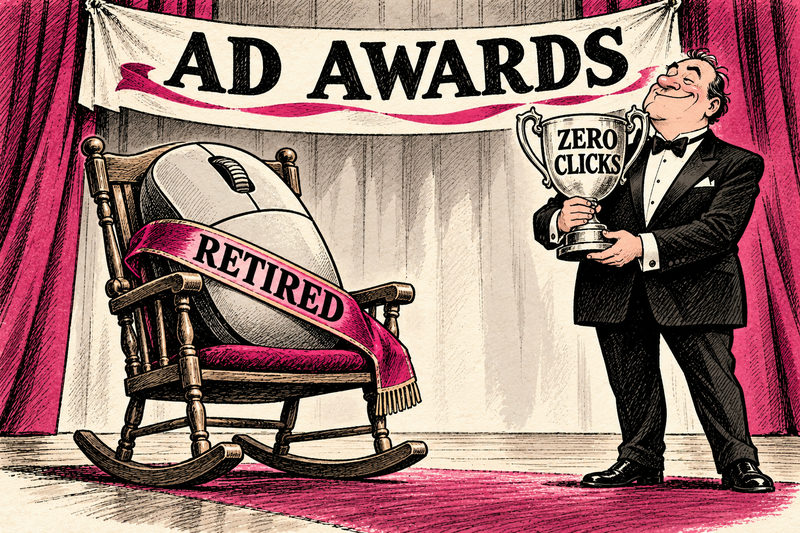
The advertising industry has spent years asking how to get you to click. The spyware business has apparently asked the more ambitious question: why are we still waiting for you?
Citizen Lab researchers say targeted online advertisements have been used to deliver zero-click mercenary spyware. As reported by the Guardian, they believe devices at Al Jazeera were compromised through ads run by Discover-Tech. The researchers describe a system that can profile people and help third-party spyware operators target selected devices without a click. That is the research finding being reported, not a court verdict, and it does not mean every person shown one of the company’s ads was infected.
The awards ceremony below is fictional. Nobody should mistake our imaginary trophy for a real industry endorsement. It has not passed due diligence, although neither has the table arrangement.
Best Reduction In Customer Friction
Our imaginary host takes the stage beneath a banner reading SEAMLESS ENGAGEMENT. He congratulates everyone who has worked so hard to make the internet feel less like a place you visit and more like a place through which you are escorted.
“For too long,” he says, “the customer journey has contained a customer decision.”
The audience winces. Several people remember losing a sale to a person who simply did not want the thing. An outdated business model, dependent on the whims of the person whose device was involved.
The fictional nominees include a button made slightly larger, a button made slightly pinker and a system that has stopped considering the button an essential member of the team.
The button receives a warm tribute. It has served the industry well, standing between interest and action, wearing whatever reassuring color the test group preferred. But the organization is moving forward. The button will be available to spend more time with its hover state.
An Impression That Really Gets Inside You
The actual reporting distinguishes the broad reach of the advertising operation from the particular targets researchers believe were hacked. An ad impression is not automatically an infection. The troubling point is that the researchers describe a route from ordinary ad delivery to selected-device compromise, not a magical curse in every banner.
Our imaginary presenter is delighted by the efficiency of that distinction. Why drag everyone through the same experience when personalization can make the invasion feel bespoke?
The fictional acceptance speech thanks the user for doing absolutely nothing. No cumbersome form. No ill-advised link. No rewarding moment when a security trainer can freeze the presentation and explain which tiny mistake you made.
This is not a failure of consumer enthusiasm. It is a demonstration of how little enthusiasm a sufficiently intrusive business arrangement needs.
The award itself is invisible. So is the ceremony’s imaginary exit. Both are described as intuitive by people who already know where they are.
The host saves the evening’s most prestigious category for last. It honors the person at the center of the entire experience, whose participation has been so comprehensively streamlined.
The final prize is Audience Choice. The audience will be informed of its choice later.
The Comment Section Has Entered The Chat.
Argue the point. Add a joke. No threats, harassment, hate speech, spam, private personal information or unsupported accusations. First-time comments and comments with links are moderated. Comment Rules
Loading comments…
Questions or deletion requests? Contact Us. We retain comments and moderation records until removed. Only hashed email identifiers are stored for comment accounts.